

With the 2026 FIFA World Cup moving closer, the resale ticket market is starting to show a clearer pattern for fans still deciding when — and where — to buy. Prices remain high for host-nation games, marquee international matchups, and the final rounds of the tournament. But compared with earlier World Cup ticket market snapshots from February and late March, the latest marketplace data shows a more buyer-friendly market in several key areas, especially across the Group Stage and parts of the Round of 32.
The trend does not mean every World Cup match is getting cheaper. Some premium games are still holding firm, and others have moved in different directions depending on the teams, city, and available seating mix. But for shoppers who are flexible on matchup or location, the May snapshot suggests that more realistic entry points are beginning to appear as the tournament approaches.
This analysis is based on a snapshot of available asking prices on TicketClub as of Friday afternoon (May 8). We are using get-in price to refer to the lowest available listed price for a match, median listing price to describe the midpoint of available listings, and typical range to describe the 10th–90th percentile shopping band. Those numbers together give a better picture than the cheapest ticket alone, because some matches have a low floor but still move quickly into higher price territory once shoppers compare broader seating options.
World Cup Ticket Prices Have Eased Most Clearly in the Group Stage
The clearest macro trend is that the Group Stage has become more approachable since February. In TicketClub’s Feb. 19 snapshot, Group Stage matches carried an overall get-in of $184 and a median listing price of $1,291. By March 25, those figures had moved to a $154 get-in and a $1,161 median. As of the May 8 snapshot, the Group Stage get-in is now $134, while the median across available Group Stage listings has moved below $1,000, to $928.
That is a meaningful shift for fans because it suggests the market is not only producing a few isolated cheap seats. The middle of the Group Stage market has also become more manageable. For buyers who simply want to experience the World Cup in person, rather than chase one specific premium matchup, that is where the current market looks most useful.
How World Cup Ticket Prices Have Moved Since February
TicketClub marketplace snapshots show the clearest softening in Group Stage and early knockout pricing, while later rounds remain comparatively firm.
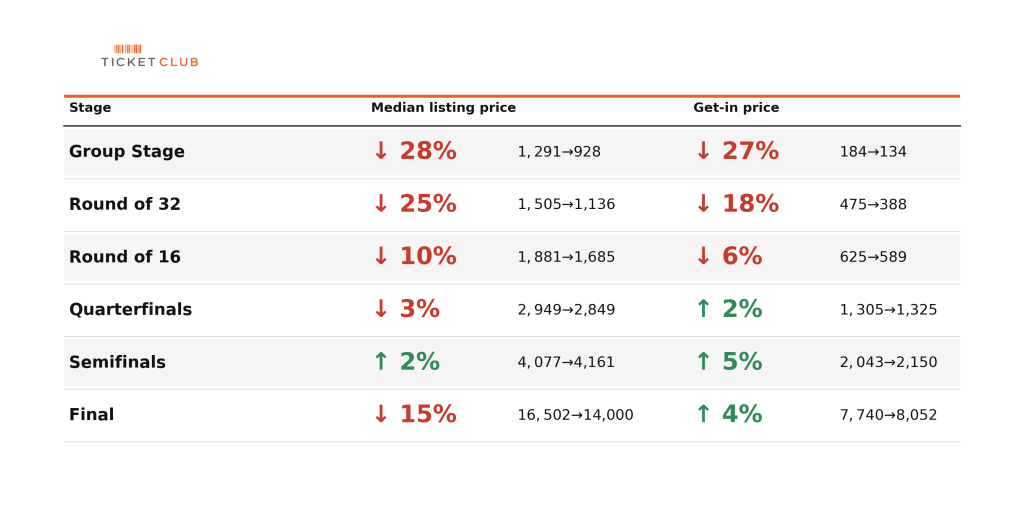
The stage-level pattern is important. Group Stage and Round of 32 medians are both down meaningfully from February. The Round of 16 has eased as well, but less dramatically. Once the tournament reaches the quarterfinals and semifinals, the market becomes much more resistant to broad softening. Those rounds are still being priced around scarcity, location, and the possibility that a major team lands in a high-demand city.
The Final is its own case. The May 8 median of $14,000 is down from the mid-$16,000 range seen in February and March, but the get-in remains above $8,000. That suggests some adjustment in the middle of the available market, not a broad collapse at the entry point. Fans looking at the Final should still treat it as the most premium ticket of the tournament.
Where the Lowest Group Stage Entry Points Are Showing Up
For flexible shoppers, the most useful part of the May data is the growing list of Group Stage matches with get-ins below $250. These games are not necessarily the cheapest by every measure, but they offer the most approachable starting points for fans who want to get into a World Cup match without paying host-nation or knockout-round premiums.
| Date | Match | Location | Get-in | Median | Typical range | Shop |
|---|---|---|---|---|---|---|
| June 22 | Group J: Jordan vs. Algeria | Santa Clara (Levi’s Stadium) | $134 | $363 | $192 – $946 | Shop |
| June 16 | Group J: Austria vs. Jordan | Santa Clara (Levi’s Stadium) | $134 | $299 | $165 – $1,043 | Shop |
| June 24 | Group B: Bosnia-Herzegovina vs. Qatar | Seattle (Lumen Field) | $156 | $358 | $215 – $1,098 | Shop |
| June 27 | Group J: Algeria vs. Austria | Kansas City (Arrowhead Stadium) | $162 | $306 | $206 – $914 | Shop |
| June 26 | Group H: Cape Verde vs. Saudi Arabia | Houston (NRG Stadium) | $171 | $342 | $242 – $1,208 | Shop |
| June 27 | Group K: DR Congo vs. Uzbekistan | Atlanta (Mercedes-Benz Stadium) | $176 | $330 | $201 – $1,043 | Shop |
Those markets show why median pricing matters. Austria vs. Jordan in Santa Clara has one of the lowest get-ins in the tournament and a median just under $300, which suggests the lower end of that market is not limited to a single unusually cheap listing. Jordan vs. Algeria also starts at $134, though its median of $363 and wider shopping range show that prices still climb depending on location and seat quality.
From a consumer standpoint, these are the kinds of matches that can make World Cup shopping more practical. They may not carry the same demand profile as Mexico, the United States, Brazil, Argentina, Portugal, or other global draws, but they offer a way into the tournament atmosphere at a much lower price point than the most expensive Group Stage games.
Premium Group Stage Games Are Still Holding Their Value
The market is not soft across the board. The most expensive Group Stage matches are still being driven by host-nation demand, major traveling fan bases, and global-team appeal. Colombia vs. Portugal in Miami Gardens is currently the highest-median Group Stage match in the May 8 snapshot, with a $2,634 get-in and a $3,898 median listing price. Mexico’s opening match against South Africa in Mexico City remains one of the tournament’s marquee early events, with a $1,911 get-in and a $3,224 median.
| Date | Match | Location | Get-in | Median | Typical range | Shop |
|---|---|---|---|---|---|---|
| June 27 | Group K: Colombia vs. Portugal | Miami Gardens (Hard Rock Stadium) | $2,634 | $3,898 | $2,955 – $5,374 | Shop |
| June 11 | Group A: Mexico vs. South Africa | Mexico City (Estadio Azteca) | $1,911 | $3,224 | $2,149 – $5,490 | Shop |
| June 18 | Group A: Mexico vs. South Korea | Zapopan (Estadio Akron) | $2,269 | $3,105 | $2,381 – $5,112 | Shop |
| June 24 | Group A: Mexico vs. Czechia | Mexico City (Estadio Azteca) | $1,078 | $2,258 | $1,143 – $3,458 | Shop |
| June 24 | Group C: Scotland vs. Brazil | Miami Gardens (Hard Rock Stadium) | $1,467 | $2,142 | $1,709 – $3,256 | Shop |
| June 12 | Group D: United States vs. Paraguay | Inglewood (SoFi Stadium) | $928 | $2,055 | $1,287 – $4,096 | Shop |
Mexico remains one of the clearest pricing drivers in the tournament. Even after some softening from earlier snapshots, Mexico’s Group Stage matches are still priced well above the broader Group Stage market. The opener in Mexico City is no longer showing the extreme $7,000-plus median seen in February, but at more than $3,200 in the May 8 snapshot, it still sits firmly in premium territory.
The U.S. market is also still elevated, though the May data suggests some movement from earlier levels. United States vs. Paraguay in Inglewood now shows a $928 get-in and $2,055 median, down from the $1,327 get-in and roughly $3,250 median listed in the February snapshot. That is still a premium Group Stage ticket, but the move is notable for shoppers who were priced out earlier in the year.
Colombia vs. Portugal is the clearest example of a match that has not followed the broader softening trend. In late March, TicketClub’s snapshot showed that match with a median still near $3,843. The May 8 data shows the median at $3,898, with the get-in now at $2,634. That is the profile of a durable premium market: the cheapest entry point may shift, but the broader center of the market remains high.
Host City Patterns Are Becoming Easier to See
Host city matters nearly as much as matchup. In the May 8 Group Stage data, Mexico City remains the most expensive host market by median listing price, followed by Miami Gardens, Zapopan, Arlington, and East Rutherford. Those cities are benefiting from a combination of host-nation demand, major international teams, and large event-market dynamics.
On the other side of the market, Atlanta, Santa Clara, Kansas City, Vancouver, and Seattle currently show more approachable Group Stage medians. That does not mean every match in those cities is cheap, but it does mean flexible shoppers may find more room to compare options before committing.
| Host City | Group Stage Get-in | Group Stage Median | General Read |
|---|---|---|---|
| Mexico City | $627 | $2,258 | Most premium host-city market in the May snapshot |
| Miami Gardens | $258 | $1,394 | High ceiling because of Colombia, Portugal, Brazil, and Uruguay interest |
| Zapopan | $319 | $1,382 | Strong Mexico-driven demand, with some softer non-Mexico pricing |
| Arlington | $327 | $1,344 | Firm market with Argentina and other high-interest matchups |
| Atlanta | $176 | $398 | One of the most buyer-friendly Group Stage host markets in this snapshot |
| Santa Clara | $134 | $408 | Low entry points and several practical value options |
For buyers, the city split is useful because it creates a more practical shopping strategy. If the goal is to see a specific team, the matchup will drive the decision. But if the goal is to attend the World Cup and build a trip around the best available value, the May data suggests that some cities offer a much more flexible buying environment than others.
Knockout Rounds Still Carry Scarcity Pricing
The biggest divide in the market still arrives when the tournament moves into the knockout rounds. The Round of 32 has softened from February, with the median moving from $1,505 to $1,136 in the May 8 snapshot. But pricing remains meaningfully above the lowest Group Stage markets because buyers are paying for elimination-round stakes before the bracket is fully known.
The Round of 16 is steadier, with a May median of $1,685, down from $1,881 in February. Quarterfinals and semifinals are less forgiving. The quarterfinal median is $2,849, only slightly below February’s $2,949, while the semifinal median is slightly higher than it was in February. That pattern is consistent with a scarcity-driven market: once there are only a handful of matches left, the specific teams matter, but the limited number of games already creates a premium.
The Third-Place Match in Miami Gardens is a notable contrast. Its $827 get-in and $1,464 median are far below the Final and below many late-round knockout prices. For fans who want a final-weekend World Cup event without paying Final-level prices, that match may be worth watching closely.
The Final Is Softer in the Middle, But Still Extremely Expensive
The Final at MetLife Stadium remains the tournament’s defining premium event. The May 8 snapshot shows an $8,052 get-in and a $14,000 median listing price, with a typical shopping range of roughly $9,527 to $25,325. Compared with February and March, the median has moved down meaningfully. But the get-in has not followed the same path. It remains above $8,000, roughly in line with where it stood in late March.
That distinction matters. A lower median suggests some sellers have adjusted expectations in the middle of the market, but the floor is still holding at a level that puts the Final in a separate category from the rest of the tournament. Fans shopping that match should not read the May trend as a sign of bargain pricing. It is better understood as a premium market showing some movement, not a soft market becoming broadly accessible.
What Fans Should Take From the May World Cup Ticket Market
The May 8 snapshot gives shoppers a clearer picture than earlier in the year. The market is becoming more segmented, and that is helpful for buyers. Group Stage value options are easier to identify. Some Round of 32 and Round of 16 pricing has eased from February levels. At the same time, host-nation matches, premium international teams, semifinals, and the Final continue to behave like high-demand events.
The practical takeaway is that World Cup shoppers should decide whether they are buying a specific match or buying the broader tournament experience. If the goal is Mexico, the United States, Brazil, Portugal, Argentina, or a late-round knockout game, premium pricing is still the expectation. If the goal is to be inside a World Cup stadium, the current market has more realistic paths than it did earlier this year.
TicketClub members may find added value in this kind of market because membership unlocks discounted resale ticket pricing on available seats. Anyone can browse TicketClub, but members can compare the lower member price against the standard non-member all-in price before buying. For high-demand events or multi-ticket orders, those savings can be meaningful, especially when World Cup prices vary so widely by match and city.
Fans can shop available World Cup Soccer tickets on TicketClub and compare current listings for matches across the tournament. All orders are backed by the TicketClub Guarantee, including valid tickets and on-time delivery.