

Update (Monday morning, Jan. 19, 2026): If you’ve been watching ticket prices for the College Football Playoff National Championship at Hard Rock Stadium and hoping the market would soften as kickoff approached, this matchup is still resisting the usual late dip. In fact, the floor has continued to rise. Based on current Ticket Club member listings this morning, the get-in price is now roughly $3.7K per ticket, up from $3,400 on Sunday afternoon — a clear sign that the cheapest inventory has been bought up, repriced, or pulled as game time approaches.
That upward pressure at the bottom is important, because it’s usually the first place you’d expect weakness to show up on game day. Instead, the market continues to behave like a one-off event with outsized demand — and that tracks with the same two forces driving this championship from the start: Miami playing in its home stadium, and Indiana chasing a program-defining, once-in-a-lifetime moment.
What’s moving (and what isn’t) in the final hours: The “budget lane” is tightening, with sub-$4.5K options still overwhelmingly concentrated in the upper deck. Lower bowl and 200-level “value pockets” remain about location, not luck, while premium inventory is still posting headline numbers — including 72 Club seats above $20,000 per ticket — a sign that top-end sellers are holding firm for late-arriving buyers who prioritize experience over price.
How to shop smart today: If you’re optimizing for lowest price, focus on the 300 level and be ready to move quickly when a listing hits your comfort zone. If you want the lower-bowl experience, target corners and end zones first to avoid the full midfield tax. If you’re set on sideline or midfield views, expect pricing to remain sticky unless a seller blinks late — and understand those “drops” can appear and vanish fast.
Update (Sunday afternoon, Jan. 18, 2026): If you’ve been watching ticket prices for the College Football Playoff National Championship at Hard Rock Stadium and hoping the market would soften as kickoff approached, the latest inventory says otherwise.
With the game now less than 24 hours away, this is typically the window where the ticket market finally starts to move — where last-minute buyers surge in because time is running out, and sellers face the reality that unsold tickets at kickoff can turn into a total loss.
But for Indiana vs. Miami, the market hasn’t followed the usual “late dip” script. In fact, it has firmed up.
As of Sunday afternoon (Jan. 18), the overall get-in price for Ticket Club members sits at $3,400, with a median asking price of $5,225. That’s a meaningful jump from our Monday morning update last week, when the get-in price was $2,991 and the median sat at $4,640.
In other words: the floor rose, the middle rose, and the market is still pricing this game like a once-in-a-generation event — not a typical neutral-site championship.
Why the “last-minute selloff” hasn’t arrived
The story behind these numbers is the same story that’s been powering this market from the beginning — and it only gets stronger as game day approaches.
Miami is effectively playing a national championship in its own backyard. Even though the game is branded as neutral-site, Hard Rock Stadium is still the Hurricanes’ home field. That eliminates the biggest barrier that normally limits last-minute demand: travel. Miami fans don’t need to book flights, take extra days off work, or commit to a full weekend trip. They can decide on Sunday night or Monday morning and still be in the building.
That kind of local accessibility keeps late buyers in the market — and late buyers are exactly what keeps the get-in price from sliding.
On the other side, Indiana is living a dream season that fans may never get back. This is the kind of “history happening in real time” run that turns ticket-buying from a rational decision into an emotional one. Alumni groups activate. Families decide they’ll regret it if they don’t go. Fans who wouldn’t normally travel for football decide this is the exception.
And when urgency is emotional, people don’t always wait for deals.
Put those together and you get a market that’s behaving more like a hometown mega-event than a traditional championship game. The demand is broad, the motivation is high, and sellers haven’t been forced to blink — at least not yet.
The shape of the market: where “last-minute options” really live
There is still meaningful inventory available — but it isn’t evenly distributed across the stadium, and that matters if you’re shopping in the final hours.
The biggest takeaway for last-minute buyers is that the remaining “entry points” are concentrated in the 300 level. That’s where the current get-in lives, and it’s where most shoppers will find the broadest range of realistic options.
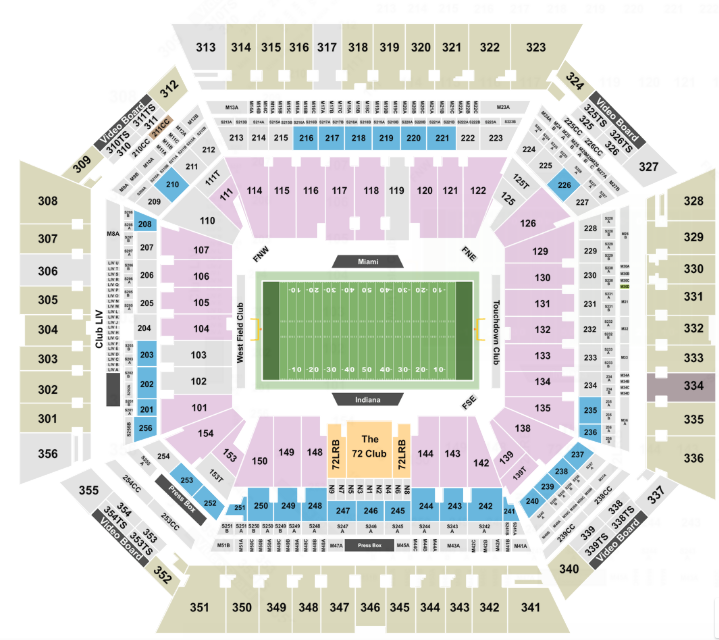
Here’s the current shape of pricing by level:
- 300 Level: Get-in $3,400 | Median $4,212
- 100 Level: Get-in $4,399 | Median $6,396
- 200 Level: Get-in $4,482 | Median $6,048
- 72 Club (premium midfield): Get-in $14,513 | Median $15,884
Even at a glance, the story is clear: you can get in the door for $3,400, but the moment you start trying to upgrade the experience, the market starts charging championship-level premiums.
The biggest shopping reality: under $4,500 is basically an upper-deck budget
If you want one statistic that explains what this market looks like on the eve of kickoff, it’s this:
If your budget ceiling is $4,500, you should expect to shop almost entirely in the 300 level.
There are a few exceptions — occasional corner or end-zone seats outside the upper deck that slip under that number — but they’re limited and tend to disappear quickly. At this stage, if you see a lower-bowl or club-adjacent listing under $4,500 that fits your needs, it’s the kind of opportunity you can’t assume will be there an hour later.
The practical takeaway is simple: if your budget is under $4,500, plan on the upper deck — and shop quickly when you see a listing you can live with.
The lower bowl is really two different markets
Once you move into the 100 level, the lower bowl stops behaving like one unified tier. There’s a meaningful difference between end zones/corners and the sideline/midfield core, and the pricing reflects it.
On the lower-bowl “value” side (end zones and corners), the market is still brutal — but it’s at least within range for fans who are already spending in the mid-$4Ks to mid-$6Ks per seat. It can be the most realistic path to the “lower bowl experience” without paying the true midfield premium.
On the sideline/midfield side, it’s a completely different universe. Lower sideline listings begin around $6,000+, and midfield pricing pushes past five figures quickly. For premium sideline/core inventory, the typical asking price is north of $8,000 per ticket, with some listings stretching as high as $18,000+.
That’s the “experience tax” in action. When the building is expected to be a championship cauldron — and when you have a home-team dynamic — buyers pay a premium for the best views, the best sightlines, and the best chance to say they were right in the heart of it.
200 level: not cheaper than the lower bowl, but still highly desirable
The 200 level is often misunderstood by shoppers who assume “higher level” means cheaper. In this market, the 200 level isn’t really a discount tier — it’s an experience tier.
The entry point in the 200 level is still in the mid-$4Ks, and the median is roughly in the low-$6Ks. It’s not a way to get into the building cheaply. It’s a way to get a clean view, a comfortable vantage point, and a more consistent seating experience than the 300 level — without paying the true midfield lower-bowl premium.
And yes, this level still includes headline-grabbing extremes. One of the most eye-popping listings in the entire inventory is priced above $50,000 — a clear outlier, but a reminder that premium inventory in a title game often attracts luxury pricing that has little to do with the typical fan experience.
Premium inventory: the ceiling remains absurd
If you’re a super-premium buyer, the market is still offering trophy-case options — and pricing them like one-of-one experiences.
The 72 Club inventory (midfield premium) is currently sitting with a get-in above $14,000 per seat and a median north of $15,000. Listings reach into the mid-$20Ks, and select “perfect location” offerings are priced as if they’re collectibles.
This is not where most fans are shopping — but it’s part of why the overall market feels record-level. When the floor rises and the premium end stays inflated, the entire event takes on an aura of scarcity and significance.
What to expect on Monday: where prices might move (and where they probably won’t)
If this market is going to show any last-minute softness, it will almost always appear first in the places where inventory is deepest — which means the 300 level, especially corners and end-zone areas.
That’s where sellers have the most competition and where buyers have the most choices, so it’s the most likely area for a short-lived dip if a few sellers decide they want out.
But don’t expect the same kind of movement everywhere.
- Upper corners/end zones: most likely area to see small price breaks
- Lower end zones/corners: may show occasional deals, but they are limited and can vanish quickly
- Lower sidelines and midfield premium: tends to remain sticky because the buyer pool is different
- 72 Club: typically negotiates the least, because these seats are marketed as status experiences
The other variable to watch is simple: Miami’s presence keeps demand alive late. If there’s a Monday surge — locals deciding to go because it’s a home championship — it can absorb inventory quickly and keep pressure on the get-in price even on game day.
The bottom line
As of Sunday afternoon (Jan. 18), this market has not “cracked” in the way fans often hope it will. The get-in price is higher than it was last week, the median is higher, and the lowest-price path into the stadium is still overwhelmingly concentrated in the 300 level.
That’s the clearest sign that this isn’t a typical neutral-site championship dynamic.
Miami’s home-stadium factor keeps last-minute buyers in play. Indiana’s historic run keeps urgency high. And with the game now hours away, sellers appear willing to hold their ground unless the market forces them to blink.
If you’re shopping tonight or tomorrow, the smartest approach is to decide what matters most — lowest price, lower bowl, or premium view — and then be ready to move quickly when you see the right listing. In a market like this, the “perfect deal” may never arrive — and the best opportunities can disappear in a single refresh.